

Jinan Power Flight International Company Ltd.: Your Professional Alloy Saw Blade Manufacturer!
Jinan Power Flight International Company Ltd. is a global manufacturer and supplier dedicated to the innovation, production, and worldwide distribution of premium saw blades. The company's main products include saw blade, grinding tools, hole cutting tools, glass cutting tools, etc.
-
![9inch 80Teeth Woodworking Saw Blade]() 9inch 80Teeth Woodworking Saw Blade9inch 80Teeth Woodworking Saw Bladeview more
9inch 80Teeth Woodworking Saw Blade9inch 80Teeth Woodworking Saw Bladeview more
Product Model: 49009
Product Specifications: 230-80T-2.4-25.4
Segment Profile: ATB(Alternate Top Bevel) 80T -
![9inch 60Teeth Woodworking Saw Blade]() 9inch 60Teeth Woodworking Saw Blade9inch 60Teeth Woodworking Saw Bladeview more
9inch 60Teeth Woodworking Saw Blade9inch 60Teeth Woodworking Saw Bladeview more
Product Model: 49008
Product Specifications: 230-60T-2.4-25.4
Segment Profile: ATB(Alternate Top Bevel) 60T -
![9inch 40Teeth Woodworking Saw Blade]() 9inch 40Teeth Woodworking Saw Blade9inch 40Teeth Woodworking Saw Bladeview more
9inch 40Teeth Woodworking Saw Blade9inch 40Teeth Woodworking Saw Bladeview more
Product Model: 49007
Product Specifications: 230-40T-2.4-25.4
Segment Profile: ATB(Alternate Top Bevel) 40T -
![8inch 40Teeth Woodworking Saw Blade]() 8inch 40Teeth Woodworking Saw Blade8inch 40Teeth Woodworking Saw Bladeview more
8inch 40Teeth Woodworking Saw Blade8inch 40Teeth Woodworking Saw Bladeview more
Product Model: 49005
Product Specifications: 200-40T-2.4-25.4
Segment Profile: ATB(Alternate Top Bevel) 40T -
![7inch 40Teeth Woodworking Saw Blade]() 7inch 40Teeth Woodworking Saw Blade7inch 40Teeth Woodworking Saw Bladeview more
7inch 40Teeth Woodworking Saw Blade7inch 40Teeth Woodworking Saw Bladeview more
Product Model: 49003
Product Specifications: 180-40T-2.2-25.4
Segment Profile: ATB(Alternate Top Bevel) 40T -
![6.5-inch 24-tooth Alloy Saw Blade For Lithium-ion Battery Saws]() 6.5-inch 24-tooth Alloy Saw Blade For Lithium-ion Battery...6.5-inch 24-tooth Alloy Saw Blade for Lithium-ion Battery Sawsview more
6.5-inch 24-tooth Alloy Saw Blade For Lithium-ion Battery...6.5-inch 24-tooth Alloy Saw Blade for Lithium-ion Battery Sawsview more
Product Model: A604012
Product Specifications: 165-20-1.0-1.5-24T
Tooth Profile: ATB -
![10-inch 100-tooth Industrial-grade Aluminium Cutting Saw Blade]() 10-inch 100-tooth Industrial-grade Aluminium Cutting Saw ...10-inch 100-tooth Industrial-grade Aluminium Cutting Saw Bladeview more
10-inch 100-tooth Industrial-grade Aluminium Cutting Saw ...10-inch 100-tooth Industrial-grade Aluminium Cutting Saw Bladeview more
Product Model: A603001
Product Specifications: 10X100T
Tooth Profile: ATB/TCG -
![4-inch 40-tooth Woodworking Saw Blade]() 4-inch 40-tooth Woodworking Saw Blade4-inch 40-tooth Woodworking Saw Bladeview more
4-inch 40-tooth Woodworking Saw Blade4-inch 40-tooth Woodworking Saw Bladeview more
Product Model: A601002
Product Specifications: 4X40T
Tooth Profile: ATB (Alternate Top Bevel) -
![Wood Working Saw Blade]() Wood Working Saw BladePower Flight International, 25 years of expertise in saw blades.view more
Wood Working Saw BladePower Flight International, 25 years of expertise in saw blades.view more
Specialist in wood working saw blade. -
![Aluminum Cutting Saw Blade]() Aluminum Cutting Saw BladePower Flight International, started from the year 2000, 25 years of expertise in saw blades.view more
Aluminum Cutting Saw BladePower Flight International, started from the year 2000, 25 years of expertise in saw blades.view more
Specialist in aluminum cutting saw blade. -
![Lithium Powered Saw Blade]() Lithium Powered Saw BladePower Flight International, a trusted specialist in alloy steel blades area. Together with my 25 years experience, got the blades that the best fit for you, and start our win-win business.view more
Lithium Powered Saw BladePower Flight International, a trusted specialist in alloy steel blades area. Together with my 25 years experience, got the blades that the best fit for you, and start our win-win business.view more
Specialist in lithium powered saw...


Why choose us?
Professional team
Power Flight International boasts a dedicated team of 50 professional technicians committed to delivering unparalleled expertise and rapid response, ensuring a seamless and worry-free cooperation experience.
Quality control
With a 5,000 square meters' modern facility and five advanced production lines, we adhere to the ISO 9001 Quality Management System to ensure stricter quality control, more stable production supply, faster order fulfillment, ample inventory to meet your market demands.
Customized services
We offer comprehensive customized solutions, providing tailor-made saw blade services to meet your exact requirements-including material, tooth profile, dimensions, and all critical details-ensuring perfect adaptation to your specific working conditions and eliminating all operational challenges.
Advanced manufacturing technology
Through independent research and development in ultra-hard coating technology and low-noise tooth design, combined with advanced manufacturing processes including hot-pressing technology and spherical metal powder encapsulation granulation to enhance our blades' sharpness, durability, and cutting efficiency - eliminating all your post-purchase concerns.
Advantages of Alloy Saw Blade
Toughness
One advantage of carbide-tipped saw blades is their toughness. Carbide is even tougher than steel, and it is better at holding up to the damage silica particles, small rocks, and mineral deposits can do. In addition, if there are any staples, nails, or screws in the wood you are cutting, you won’t need to worry about them damaging a carbide-tipped blade, as it can simply cut right through.
Sharpness
Another benefit of carbide-tipped saw blades is the way they remain sharper longer than steel does. You won’t have to worry about scheduling sharpening services nearly as often as you would have to with a steel blade. In addition, sharp blades will ensure your power saws can work as efficiently as possible.
Longevity
The last advantage of carbide-tipped saw blades we’ll cover here is their superior longevity. A carbide-tipped blade lasts much longer than a steel blade, and it is a better investment in the long run.

Product Specifications
|
Model |
Specification |
Tooth Counts |
Diameter |
Core Size |
Cutting Head Thickness |
Weight |
|
A490 |
110D-20H-2.0T |
30 Tooth |
110mm |
20mm |
2.0mm |
84g |
|
110D-20H-2.0T |
40 Tooth |
110mm |
20mm |
2.0mm |
94g |
|
|
180D-25.4H-2.2T |
40 Tooth |
180mm |
25.4mm |
2.2mm |
330g |
|
|
180D-25.4H-2.2T |
60 Tooth |
180mm |
25.4mm |
2.2mm |
350g |
|
|
200D-25.4H-2.4T |
40 Tooth |
200mm |
25.4mm |
2.4mm |
490g |
|
|
200D-25.4H-2.4T |
60 Tooth |
200mm |
25.4mm |
2.4mm |
510g |
|
|
230D-25.4H-2.4T |
40 Tooth |
230mm |
25.4mm |
2.4mm |
610g |
|
|
230D-25.4H-2.4T |
60 Tooth |
230mm |
25.4mm |
2.4mm |
630g |
|
|
230D-25.4H-2.4T |
80 Tooth |
230mm |
25.4mm |
2.4mm |
650g |
|
|
250D-25.4H-2.6T |
60 Tooth |
250mm |
25.4mm |
2.6mm |
790g |
|
|
250D-25.4H-2.6T |
80 Tooth |
250mm |
25.4mm |
2.6mm |
810g |
|
|
250D-25.4H-3.0T |
100 Tooth |
250mm |
25.4mm |
3.0mm |
830g |
Precautions for Using Alloy Saw Blade
When working, the workpiece should be fixed, and the profile positioning should be consistent with the direction of the cutting tool to avoid abnormal cutting. Do not apply side pressure or make curved cuts. Workpieces fly out and accidents occur.
When working, if you find abnormal sounds and vibrations, rough cutting surfaces or odors, you must stop the work immediately and check in time to eliminate faults to avoid accidents.
When starting and stopping cutting, the feed speed should not be too fast to avoid tooth breakage and damage.
If cutting aluminum alloy or other metals, special cooling lubricant should be used to prevent the saw blade from overheating, causing damage to toothpaste, etc., and affecting the cutting quality.
The equipment has a chip removal chute and a slag suction device to ensure smooth flow channels and prevent slag accumulation from affecting production and safety.
When dry cutting, please do not cut continuously for a long time to avoid affecting the service life and cutting effect of the saw blade; when cutting wet, add water during cutting to prevent water leakage.
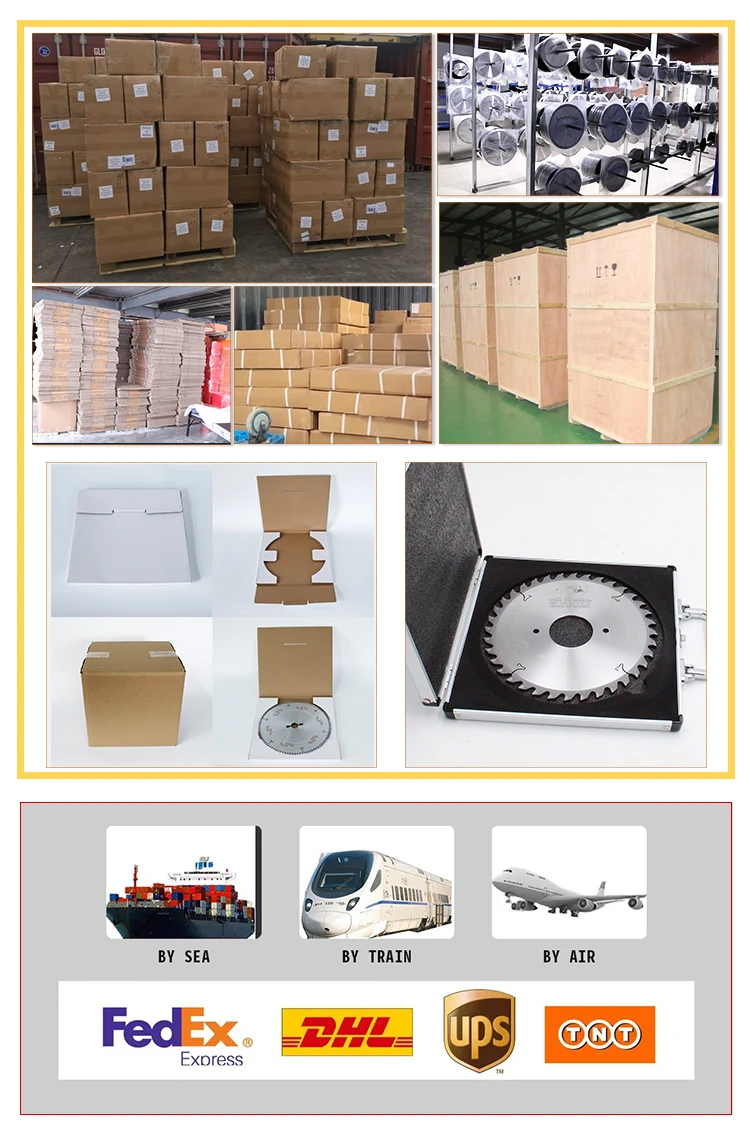
Packaging and Shipping
FAQ
We're well-known as one of the leading alloy saw blade suppliers in China. Please feel free to buy high quality alloy saw blade for sale here from our factory. Good service and reasonable price are available.
alloy saw blade, Lithium Powered Saw Blade, Aluminum Cutting Saw Blade


